Saturday, April 25, 2015

Cuzco-Part 1

My friend Shannon came to visit from the US, and we decided that we wanted to see Machu Picchu. After spending a few days in Lima, we headed off to Cuzco.

Despite being known as the gateway to Machu Picchu, Cuzco has it's own place in history.  As the oldest continually-inhabited city in South America, it has a unique mix of ancient and modern culture that charms the travelers that pass through.

However, that charm was not immediately apparent as we arrived, already sick, into the cold, rainy afternoon.  Luckily, after a good night's sleep (and an improvement in the weather), we were off to explore what the city had to offer: first on our own, then with a guided tour of the nearby Inca sites.
The Plaza de Armas

La Catedral

Parades must be a big thing here-we saw one on both days that we spent in Cuzco.


The view from La Catedral


A depiction of colonial Cuzco

Monument on Av El Sol, the main business district

Modern artwork, ancient theme
There are tons of these women who dress up in traditional costumes and bring their llamas to take pictures with the tourists.  Cuzco, by location, is a bit of a tourist trap, so you really do have to be careful.

...But it doesn't mean you can't have fun with it! 

Even the street dogs in Cuzco were friendlier-maybe that also contributes to part of the charm!

Tuesday, April 14, 2015

Chiclayo

Since I had a few extra days for the Semana Santa (Holy Week) holiday, I wanted to travel beyond the limits of what I had seen before. A friend suggested wandering through the central highlands-mainly around Tarma, which, by all accounts, has a fantastic Semana Santa celebration-to the central jungle, ending up in Oxapampa. I thought it was a great plan. Unfortunately, the weather didn't agree...

For those of you that may not know what's happening here in Perú, it has been raining in the central region. Unfortunately due to the El niño effect, it has been raining more than usual and causing devastating landslides throughout the region. A state of emergency was even declared by the President of Perú.

Being that we would have had to pass through this area on our journey to the jungle, we had to alter our plans.  Plans B (Huaraz) and C (Cajamarca) were discussed and discarded and we ended up on Plan D (the North Coast).  Of course, since we changed plans last minute, we had very little time to do any planning, but we managed to enjoy ourselves despite that.  I got to eat more great food-arroz con pato (rice with duck), tortilla de mantaraya (this is kind of like an omelette with pieces of manta ray), ceviche with different kinds of fish, and, of course, lots of chicha de joya; I got to see more pre-Incan ruins; and I got a nice sunburn from the beach.

Chiclayo and the neighboring towns, Lambayeque, Ferreñafe, and Túcume have some great museums to visit and we took advantage of that fact.  First we went to see the Museo Nacional Sicán, a museum dedicated to Sicán culture.  Sicán culture thrived between 750 and 1375 AD, right between the two sites I visited previously.


It houses replicas of two tombs:


The Sicán people were skilled in ceramics and metalworking, using molds to mass-produce items. They introduced the Bronze Age to the North Coast of Perú.

The museum was great!  We even got to see a special demonstration:

I got to make friends with one of the Peruvian hairless dogs there.


That night, we watched the processional for Good Friday:


The next day we decided to take a tour to visit all of the Sipán sites.  It ended up being an all day trip, but we really enjoyed it.  The sites in Sipán are all from Moche culture, like the Huaca del Sol y la Luna near Trujillo. First, we visited the Museo de sitio Túcume, from whose location you can see many of the huacas, not all of which have been excavated yet.


It was a pretty neat little museum with a lot of hands-on exhibits.  I was pretty excited that all of the signs were in both Spanish and English!


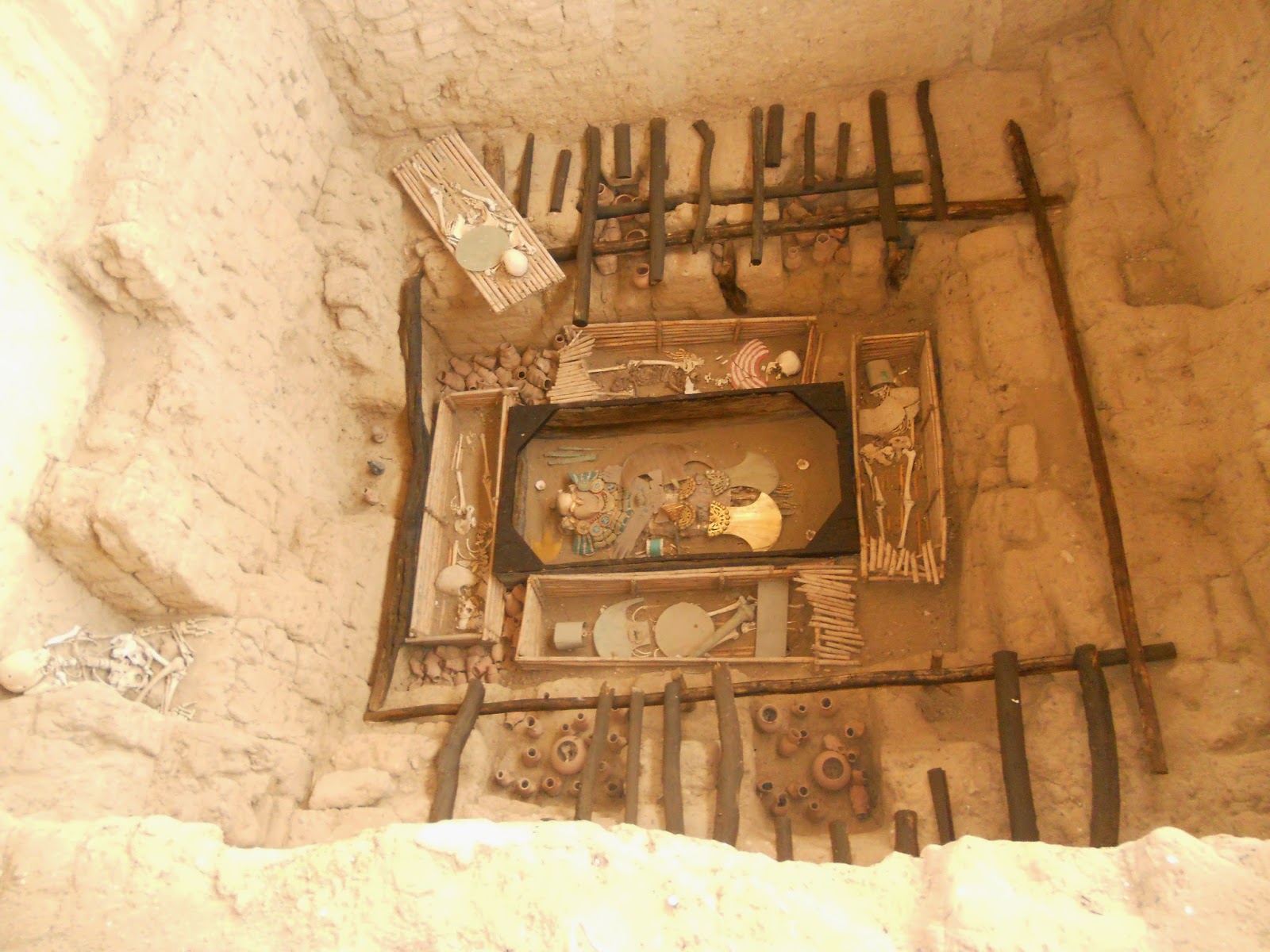
Then we moved on to the Museo de las Tombas Reales de Sipán.  This museum was built specifically to house the archaeological finds from the Huaca Rajada.  It mostly centers around the tomb of El Señor de Sipán, a local nobleman.  We weren´t allowed to take cameras, or even bags, inside, so we could only take photos of the outside of the building.

Our last stop was the Huaca Rajada itself.  Though the actual items are housed in the museum, they did set up replicas in the actual tombs, so that you could visualize what it looked like when it was discovered.


Tuesday, March 17, 2015

The Ruins

In Trujillo I also visited two pre-Inca archaeological sites.  I find it fascinating that archaeologists here in Perú manage to create popular tourist attractions while maintaining an active dig site.

First was a visit to Chan Chan.  Chan Chan was the capital city of the Chimú civilization, which flourished from the middle of the 14th century until they were conquered by the Incas in 1470.  It was a large, beautiful city whose walls were decorated with ornate adobe carvings:
These represent river otters

This is a depiction of the meeting of the Humbolt and El niño currents

The Chimú were dependent on the sea, so it is not surprising that many of their shapes represent fishing nets

I think this geometrical design represented some sort of gestalt image of a fish and a pelican

Pelicans

The Chimú worshiped the moon, so there were many rooms that were decorated with carvings of the full moon
This video is our guide demonstrating the acoustics.  She sang beautifully, but unfortunately it was very windy.


Here is a reservoir where priestesses and devotees would bathe in the light of the moon 

The Chimú used reed boats like these to fish

I also visited the Huaca del Sol y la Luna (Temple of the Sun and Moon). These ruins date to an even earlier culture, the Moche, who flourished between 100-800 AD.  Like the Chimú, the Moche worshiped the moon.  Due to the number and condition of the skeletons found at the site, it is believed that they captured their opponents in battle specifically to use them as human sacrifices in their religious rituals.  Unfortunately for me, this tour was in Spanish, so I didn't understand as much as I did in Chan Chan.


The Huaca del Sol is in the background with the urban nucleus in the foreground

We did manage to have some fun, despite the gristly history of the place:


Friday, March 13, 2015

Trujillo

Since my last trip to the south was a bit of a bust, this time I decided to head north, about 8 hours, to another city on the coast, Trujillo.  Not only was the weather expected to be better (no wind!) but I also had the advantage of meeting up with one of our students and letting him play tour guide.

I got to see many places-the ruins (more about these in the next post);


the main square;


and the beach


-but I was more excited to be able to try some new foods!

First was a new fruit called mamey (MAH-MAY).

It reminded me of an orange coconut, but tasted like (and had the texture of) a dried apricot.

Next, lunch was a specialty made here on Mondays called shambar.

It's basically a lentil soup that you add pork, red onions and yucca to.  I find it interesting that the name is so close to the Indian version of a lentil stew: sambar.  I'll have to  do some investigating to see if it is more than just coincidence!

I also had a chance to try chicha de jora, a fermented drink made of corn, which I had been wanting to try for a while.

Supposedly it packs quite the punch, but we didn't drink enough to test that out.  It definitely smells fermented, but tastes more like a nice, crisp, unpasteurized apple cider.  

Then, I tried a new fish preparation, sudado de pescado.

This was a fish soup-with the whole fish (including the head!)

Last but not least, I tried a dessert called KingKong.

Who knew that caramel, pineapple and peanut butter in one dessert could be so good?